

Student Guide · Updated 2026
How to do laundry at university: on-campus, launderettes, and what it actually costs
Most UK university halls use Circuit Laundry — an app-based system you've probably never heard of before arriving. Some universities charge over £4 per wash. One university makes it free. And if you live out from second year onwards, you'll need a public launderette entirely. Here's everything you need, in the order you'll actually need it.
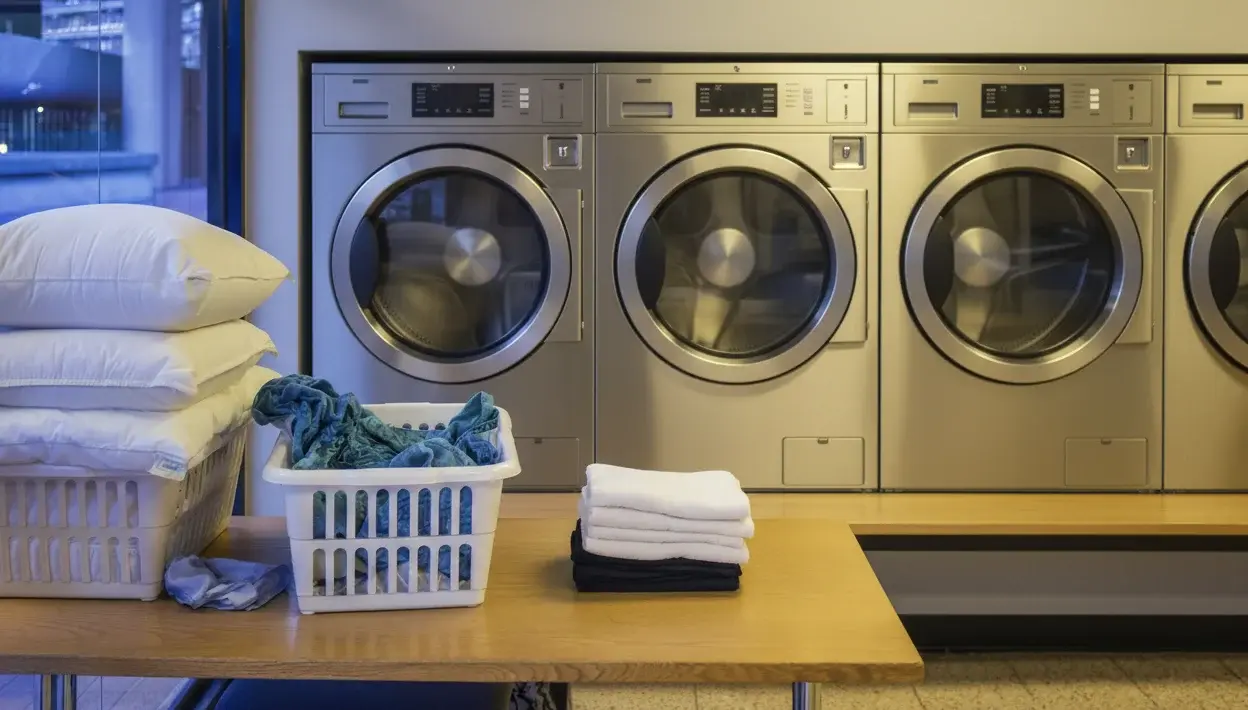
What are your laundry options at university?
Before getting into the mechanics, it helps to understand the four realistic options available to you — because most student laundry guides treat one of them as an afterthought, which is how people end up stuck on a Sunday night with a broken campus machine and no backup plan.
1. On-campus launderette (halls)
Most first-years in university accommodation will have a launderette in or near their building. These are typically operated by a commercial provider — Circuit Laundry is dominant across UK universities — and charge per wash. Access is for residents only. It's convenient when machines are available, but availability varies wildly by time of day and term period.
2. Your flat's washing machine
Some accommodations have machines built into communal kitchens — check your specific hall before assuming you need to use the shared laundry room. At Bath, for example, students in The Quads, Woodland Court, Polden, Polden Court, and Scala have in-kitchen machines. If your flat has one, you only need to think about detergent, not apps or credits.
3. Public launderette (laundromat)
The option most guides ignore. Essential for: students in private accommodation (most from second year onwards), washing duvets and large bedding, when on-campus machines are broken or full, and students whose halls don't have good provision. Open to everyone, no app required, often cheaper per kilogram than campus machines, and the drums are larger — meaning fewer loads per week.
4. Collection service (pickup laundry)
Services like Love2Laundry collect, wash, and return. Convenient, but significantly more expensive — typically £20–25 per bag, aimed at busy professionals rather than students on a budget. Worth knowing about for occasional use (freshers' week, exam period) but not a weekly solution for most people. The annual cost works out to over £700.
The broader student laundry cost problem has already been covered by Accommodation for Students, and Save the Student's washing machine guide is useful if you have access to a machine. This guide fills the gap between those two situations: what to do when campus laundry is expensive, unavailable, or not designed for larger loads.
For most students, the first few weeks mean getting to grips with the on-campus system. Here's how that works.
How on-campus laundry works at UK universities
The majority of UK universities use Circuit Laundry. You'll encounter it at Edinburgh, Bath, Nottingham, Durham, most Oxford colleges, and many others. Understanding it once means understanding it everywhere — which is more than most guides tell you before you arrive.
Two versions are in use
- Circuit Mobile Plus — requires the app (free, iOS and Android). Scan the machine's QR code, pay via app credits loaded with card or PayPal. This is the system used at Bath.
- Circuit Go — newer system at Nottingham and Edinburgh. Offers the same app, but also supports contactless tap at the machine — no app download needed at all.
How to use it — step by step
- Download the app (Circuit Go or Circuit Mobile Plus — check which your university uses)
- Create an account with your university email
- Load credit (card or PayPal — no cash)
- Go to the laundry room with your clothes and detergent (not supplied at most universities — Southampton is the exception)
- Load the machine, then open the app and scan the QR code on the machine
- Select your programme (Eco is cheapest and fine for most clothes)
- Pay through the app — the machine starts
- Set a timer for when it finishes. Return promptly — leaving clothes in a finished machine is the number one laundry room social offence
Useful features to know
- Real-time availability — check if machines are free before walking over (all Circuit systems)
- Cycle complete notifications — the app alerts you when your wash is done
- Edinburgh-specific: Circuit Go lets you reserve a machine up to two weeks in advance — useful around deadlines or during busy periods
Durham note: Durham's Circuit system uses Bluetooth to communicate between phone and machine. Make sure Bluetooth is on before you arrive at the machine.
How much does laundry cost at university?
On-campus laundry costs vary significantly across UK universities — and not just because of location. The provider contract each university or college signs with Circuit Laundry directly determines the price. Some colleges at Durham charge nearly twice what others do.
| University | Operator | Wash | Dry | Free? | Payment |
|---|---|---|---|---|---|
| University of Bath | Circuit Laundry | £2.90 | £1.60 | No | App or card |
| University of Edinburgh | Circuit Go | TBC | TBC | No | App, contactless, or chip & pin |
| University of Nottingham | Circuit Go | ~£3–4 | ~£1.50 | No | App or contactless tap |
| University of Durham | Circuit Laundry Plus | £2.40–£4.60 † | £1.40–free † | No | App (Bluetooth) |
| University of Southampton | Washpoint | £0 | £0 | Yes | App optional |
| University of Oxford | Circuit / Washstation | £1.60–£2.40 ‡ | £1.00–£1.50 ‡ | No | Smart card + optional app |
† Varies by Durham college contract — South College dryers are free; some colleges charge up to £4.60/wash.
‡ Each Oxford college contracts independently — price depends on which college you're assigned.
Southampton is the only UK university to include laundry in the rent. Since 2023, washing and drying at all University of Southampton halls is completely free — detergent pre-loaded. Every other major university charges per cycle.
Washing once a week at Bath (£2.90) adds up to roughly £100 over a 35-week academic year, before drying. At Durham's most expensive college rate (£4.60), that's £160/year for washing alone. A public launderette typically charges £3–£4.50 for a larger industrial drum — often cheaper per kilogram than campus machines, and no app required.
When a public launderette is your best option
Five situations where a public launderette is not just an alternative — it's genuinely the better choice.
1. You live in private accommodation
Most students move out of halls after first year. Private rented flats don't always have washing machines — and even when they do, a broken or shared machine makes a backup option essential. This is the single biggest use case for public launderettes among students.
2. Washing a duvet or sleeping bag
On-campus machines are standard residential drum size — typically 7–8kg. A double duvet needs at least a 10kg drum; a king-size or winter tog needs 12kg+. Trying to force a duvet into an undersized machine risks both the machine and the duvet. Public launderettes have industrial-size drums specifically for this.
3. On-campus machines are full or broken
Peak times (Sunday evening, start of term) and broken machines are a constant frustration in campus laundry rooms. A public launderette nearby means you're never completely stuck. It's worth knowing where your nearest one is before you need it.
4. You want to wash and dry in under an hour
Industrial dryers run hotter and faster than standard campus tumble dryers. In a public launderette, a full load — washed, dried, and done — takes around 45–60 minutes. Campus laundry rooms frequently have queue and waiting time on top of the cycle itself.
5. You don't have the Circuit app set up
Public launderettes don't require any app, account, or credit loading. Most accept contactless or coins. If you arrive at university without your phone fully set up, or you're visiting a friend at a different university with a different system, a public launderette is the zero-friction option.
How to use a launderette for the first time
If you've only ever used a home washing machine, a launderette feels unfamiliar. It shouldn't. The process is almost identical — the machines are just bigger, faster, and coin or contactless rather than just pressing start.
What to bring
- Your washing in a bag or laundry basket
- Washing detergent (liquid or pods — powder can leave residue in commercial machines)
- Payment — contactless, card, or coins depending on the launderette
- Something to do — a wash cycle takes 30–45 minutes, drying another 30–45 minutes
Step by step
- Check machines are available — most modern launderettes have an availability board or app. findalaunderette.co.uk listings show live availability where enabled.
- Sort your clothes — whites and lights separate from darks and colours. New coloured items should go alone on their first wash.
- Load the machine — fill to about 75% capacity. Overloading means a poor wash; underloading wastes money.
- Add detergent — liquid or pods go directly in the drum with modern machines. Check the machine for instructions.
- Select your programme — 30°C or 40°C handles most everyday clothes. 60°C for bedding and towels. Check care labels for anything delicate.
- Pay — contactless, card, or coins depending on the launderette. Check before you load (nothing worse than having to unload and move machines mid-cycle).
- Set a timer — come back when it's done. Most launderettes will move abandoned washing.
- Dry — tumble dryer or take it home to air dry. A clothes airer in your room is cheaper over time.
What not to do
- Don't mix a brand-new dark item with your whole wash — it will bleed
- Don't overfill the dryer — clothes packed tightly won't dry properly
- Don't forget to clean the lint filter before using a dryer — it's polite, and it makes drying faster
Not sure what temperature to wash something at? Check the care label. Use your phone to photograph it if you can't read the symbols.
New to launderettes entirely? Our first-time launderette guide covers the full process in detail, including machine sizes, payment, and what to do if something goes wrong. If your nearest launderette is coin-operated, our coin laundry guide explains what to bring and how change machines work.
Is a launderette cheaper than university on-campus laundry?
The short answer: broadly similar, sometimes cheaper — and the drums are bigger, which means fewer loads per week.
| Option | Cost per wash | Weekly cost | Annual cost (35 weeks) |
|---|---|---|---|
| University on-campus (Bath rate) | £2.90 wash + £1.60 dry | ~£4.50 | ~£158 |
| University on-campus (Durham high rate) | £4.60 wash + £1.40 dry | ~£6.00 | ~£210 |
| Public launderette (UK average) | £3.50–£4.50 wash + £1.50 dry | ~£5.50 | ~£193 |
| University of Southampton | £0 | £0 | £0 |
| Collection service (e.g. Love2Laundry) | ~£20–£25 per bag | ~£20+ | £700+ |
Public launderettes are not significantly more expensive than on-campus facilities — and the drums are bigger, so you're often doing fewer loads per week. On-campus prices have risen sharply in recent years (Durham students raised this in 2026), while public launderette prices have stayed relatively stable.
Southampton aside, no UK university currently subsidises laundry. The cost is real and adds up. Factor it into your weekly budget alongside food and transport.
Can I wash my duvet at university?
Campus machines can't handle most duvets. A standard university laundry machine drum is 7–8kg. A 13.5 tog double duvet weighs approximately 2–3kg dry but needs room to tumble — recommended drum size is at least 10kg. King-size duvets need 12kg minimum.
Rule of thumb: If you can't scrunch a duvet into a ball and still fit your fist in the drum, the machine is too small.
What to do instead
- Use a public launderette with large-drum machines — most have 10kg+ washers specifically for bedding
- Wash at 60°C for hygiene; check the care label first — some duvets are dry clean only
- Dry thoroughly — a damp duvet that isn't fully dried will quickly develop mildew
Sleeping bags, curtains, throws, and heavy coats all follow the same rule. Use your nearest launderette's large drum, not a campus machine.
findalaunderette.co.uk listings flag which launderettes have large-drum machines — filter by “large load” when searching.
Frequently asked questions
What is Circuit Laundry and do I need the app?
Circuit Laundry is the most common laundry provider in UK university accommodation. Depending on your university, you'll use either Circuit Mobile Plus or the newer Circuit Go. Both are free to download. At some universities (Nottingham, Edinburgh) you can pay with contactless tap instead — no app needed.
How much does laundry cost at university in the UK?
It varies. Bath charges £2.90 per wash and £1.60 to dry. Durham can cost up to £4.60 per wash depending on your college. Southampton is free — laundry has been included in rent since 2023. Budget roughly £4–6 per full laundry session at most UK universities.
Is laundry free at any UK university?
Yes — the University of Southampton has included laundry in accommodation fees since 2023. Washpoint operates the machines, detergent is pre-loaded, and there's no per-cycle charge. No other major UK university currently does this.
Can I wash my duvet in a university washing machine?
Most campus machines are too small for duvets. You need a drum of at least 10kg for a double duvet and 12kg for a king-size. Use a public launderette with large-drum machines instead — most have them specifically for bedding.
What do I need to bring to a launderette?
Washing, detergent (liquid or pods work best in commercial machines), and payment — contactless, card, or coins depending on the launderette. Check availability on findalaunderette.co.uk before you go.
How long does laundry take at a launderette?
A standard wash cycle takes 30–45 minutes. Tumble drying takes another 30–45 minutes depending on the load. Budget an hour for a complete session. Industrial machines are faster than home machines — a launderette is often quicker than you'd expect.
What if there are no washing machines in my student accommodation?
Some private rented accommodation doesn't include a washing machine. This is legal — there's no requirement for landlords to provide one. Your options are a public launderette, a laundry collection service, or negotiating with your landlord.
Can I reserve a laundry machine at university?
At the University of Edinburgh, Circuit Go lets you reserve a machine up to two weeks in advance through the app. Most other universities allow you to check live availability but not reserve. Public launderettes operate on a first-come, first-served basis.
How often should I do laundry at university?
Most students do laundry once a week, which is what most campus laundry room guides recommend to keep machine demand manageable. A full weekly wash (clothes, not bedding) fits comfortably in one load at a public launderette's larger drum.