

Repair vs Replace Guide · Updated 2026
Is It Worth Repairing a Broken Washing Machine? (And What to Do in the Meantime)
Your washing machine has broken. The drum has stopped, the lights are doing something worrying, and there is a pile of laundry that has somehow tripled in size overnight. Let's evaluate your options.
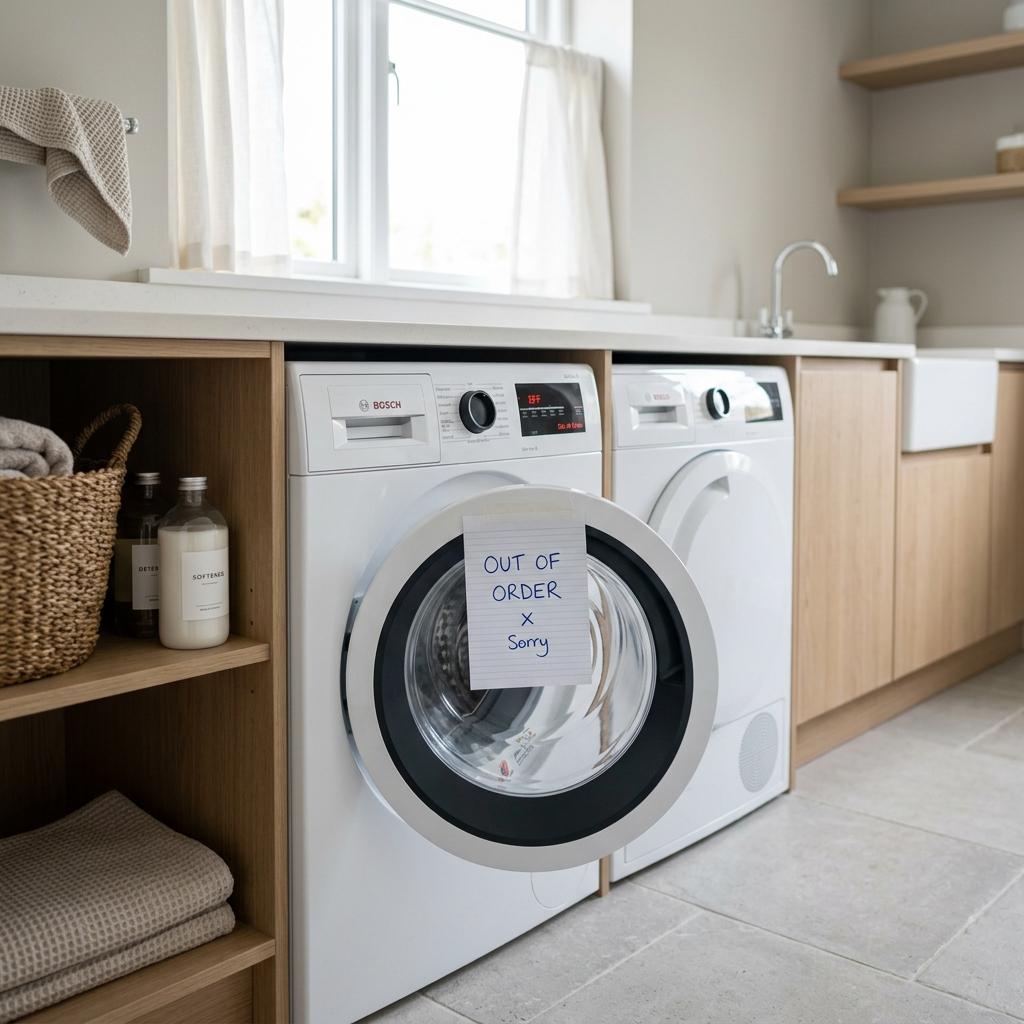
Your dirty washing can't wait three weeks for a repair engineer. Before you spend four hours researching whether a PCB fault is fixable or a death sentence, there's one more urgent thing to sort out: getting your clothes clean.
Step One: Find a Launderette Near You Right Now
This is the bit most repair-vs-replace guides forget to mention. A decision about whether to fix your machine is completely fine to park for a day or two. Your laundry is not.
A self-service launderette will handle a standard load in about 60–90 minutes, including drying. Cost: roughly £8–14 per visit depending on load size and location. That's manageable — and it means you're not making a rushed decision about a £400 repair just because you've run out of clean work clothes.
Find your nearest launderette or laundromat
Once the immediate laundry crisis is sorted, you can calmly look at the numbers.
Check Your Warranty Before Anything Else
Before you call an independent engineer or start comparing repair quotes, check whether your machine is still under warranty. In the UK, manufacturers are legally required to provide a minimum 1-year guarantee, and many offer 2 years as standard. Some retailers add their own cover on top of that.
If you bought the machine less than 2 years ago, contact the manufacturer directly before spending anything. A repair call-out you pay for on a machine still under warranty is money you didn't need to spend. The manufacturer's helpline will tell you whether you're covered and arrange a repair or replacement at no cost.
Also worth checking: home contents insurance and credit card purchase protection. Some policies cover appliance breakdown, and Section 75 of the Consumer Credit Act protects purchases over £100 made on a credit card — if the machine turns out to be faulty rather than just worn out, you may have a claim against the retailer regardless of how long ago you bought it.
If none of those apply, then the repair-vs-replace decision starts here.
Is It Worth Repairing? Start With the 50% Rule
The standard industry guideline is simple: if the repair costs more than 50% of what a new equivalent machine would cost, replacing is usually the better option.
In practice, that looks like this:
- New budget washing machine: £200–300
- New mid-range machine: £300–600
- Your 50% threshold: roughly £100–300, depending on what you'd replace it with
So if an engineer quotes £280 to fix a machine you'd replace with a £350 mid-range model, the numbers say replace. If the same quote comes in at £80 for a seal replacement on a machine you'd replace with a £500 one, fixing is the obvious call.
What Does Washing Machine Repair Cost in the UK?
Engineer Call-Out FeesThe call-out fee is charged whether or not the engineer can fix the fault. Always ask for a quote before committing to a repair visit — reputable engineers will tell you the likely fault and cost range on the phone.
According to average UK repair data, washing machine repairs run approximately £125 including the call-out fee, but the range is wide depending on what's actually wrong.
| Fault Type | Typical Cost (inc. call-out) | Notes |
|---|---|---|
| Door seal / rubber gasket | £70–100 | Common fault, low-cost fix |
| Pump or drainage issue | £100–160 | Parts vary; labour straightforward |
| Door lock / interlock | £100–150 | Often a DIY-possible fix |
| Motor brushes | £70–120 | Easy job; brushes are cheap |
| Heating element | £100–180 | Common on older machines |
| Drum bearing | £150–250 | Labour-intensive; may not be worth it on older machines |
| Pump + drum bearing combined | £200–300 | Borderline territory |
| Motor replacement | £250–350 | Consider machine age before proceeding |
| PCB / control board | £250–400 | Expensive; parts increasingly hard to source |
| Call-out fee alone | £45–125 | Charged regardless of outcome |
| Labour | £40–80/hour | Varies by region |
Data compiled from 2026 Checkatrade average cost records.
Does the Age of Your Machine Change the Calculation?
Yes, significantly. The average UK washing machine has a lifespan of 10–12 years. How you should read that number depends on where your machine sits in that range.
- Under 5 years old: Almost always worth repairing, unless the fault is catastrophic. A £150 repair on a 3-year-old machine is usually a good decision.
- 5–8 years old: Apply the 50% rule carefully. Old enough that a second fault within a year or two becomes a realistic possibility. If the repair is under £100, fix it. If pushing £200+, compare replacement quotes.
- Over 8 years old: Parts become harder to source. If the repair quote is more than £150, replacing is almost always the right call.
- Over 10 years old: Replacement is generally the better option unless it's a very minor fault (a seal, filter cleanout) coming in under £100.
Energy Efficiency SavingsWashing machines made before 2013 typically pre-date current EU/UK energy efficiency standards. A new A-rated machine running 220 cycles a year can save £30–50/year in electricity versus an older C or D-rated machine.
Age and Repair Cost Decision Grid:
| Machine Age | Under £100 | £100–200 | £200–300 | £300+ |
|---|---|---|---|---|
| Under 5 years | Repair | Repair | Repair | Get replacement quote |
| 5–8 years | Repair | Repair | Borderline | Replace |
| 8–10 years | Repair | Borderline | Replace | Replace |
| Over 10 years | Minor faults only | Replace | Replace | Replace |
Annual Cost Comparison: Home Wash vs. Launderette
To compare fairly, we align the costs by the exact same volume of laundry. Because a large commercial launderette machine holds about 2.5 times the capacity of a standard home machine, 1 launderette visit corresponds to 2.5 home loads.
Scenario A: Wash Only (Line or Air Drying)
Home washing at ~26p per cycle (electricity, water, detergent) vs. launderette wash-only at ~£6.50 per large-machine visit. Real-world reported prices: £4.50 large machine in Lewisham; £6 large machine in Zone 2 North London; under £5 in Marylebone and Stratford. Range: £4.50–£10 depending on machine size and area.
| Weekly Laundry Volume | Home Cost (Annual) | Launderette Cost (Annual) | Difference |
|---|---|---|---|
| Low — 2.5 home loads/wk ≈ 1 launderette visit | £33.80 | £338.00 | +£304.20 / yr |
| Medium — 5 home loads/wk ≈ 2 launderette visits | £67.60 | £676.00 | +£608.40 / yr |
| High — 10 home loads/wk ≈ 4 launderette visits | £135.20 | £1,352.00 | +£1,216.80 / yr |
Scenario B: Wash + Tumble Drying (Heated)
Home wash + dry at ~£1.20 per cycle vs. launderette wash + dry at ~£9 per visit. Dryers are typically time-based — commonly 50p per 6 minutes or £1 per 7–10 minutes. Community-reported drying costs: “£3 can dry a load and a half”; £4–£5 for a large load dry. Range for a complete visit: £6.50–£13 depending on location.
| Weekly Laundry Volume | Home Cost (Annual) | Launderette Cost (Annual) | Difference |
|---|---|---|---|
| Low — 2.5 home loads/wk ≈ 1 launderette visit | £156.00 | £468.00 | +£312.00 / yr |
| Medium — 5 home loads/wk ≈ 2 launderette visits | £312.00 | £936.00 | +£624.00 / yr |
| High — 10 home loads/wk ≈ 4 launderette visits | £624.00 | £1,872.00 | +£1,248.00 / yr |
Disclaimer: Home costs based on 2025 UK average electricity and water tariffs. Launderette prices use community-reported 2024–2025 figures — wash-only ranges from £4.50 (outer London/suburban) to £10+ (central/premium locations); dryers typically 50p per 6 minutes to £1 per 10 minutes. Prices vary significantly by machine size, location, and whether detergent is included. Always check your local launderette for current rates.
The Right to Repair Act — What It Means for You
Since March 2021, the UK's Right to Repair regulations require manufacturers to supply spare parts for washing machines for at least 10 years after a model is discontinued. This was a significant change: before 2021, manufacturers could effectively make machines unrepairable by withholding parts.
In practice, this means:
- If your machine was manufactured after 2021, or is a model that was still in production after 2021, an independent engineer should be able to source parts.
- Parts must be available within 15 working days of an order.
- This applies to independent repairers, not just manufacturer service centres.
The legislation doesn't cap how much parts cost, and it doesn't cover machines manufactured before the regulations came into force. But it does mean the “parts are unavailable” excuse is much harder for manufacturers to use.
How to Find a Good Repair Engineer
Three practical guidelines that separate a reliable engineer from a costly mistake:
- Ask for a phone diagnosis before booking: A competent engineer will ask you to describe the fault — error codes, sounds, behavior — and give you a likely fault range and cost estimate before coming out.
- Check whether the call-out fee is deducted from the repair cost: Most reputable engineers will absorb the call-out fee if you proceed with the repair.
- Get the quote in writing before work starts: An email or written breakdown with the fault, proposed fix, part cost, and labor cost.
What to Do While You Wait for a Repair
If you've decided to repair and you're waiting for an engineer, a launderette is the obvious answer. Most UK launderettes offer both self-service and service wash options:
- Self-service launderettes: You run the machines yourself. Standard load: 60–90 minutes wash and dry. Cost: £8–14.
- Service wash: Staff handle everything. You drop it off, pick it up later. Higher cost, but useful if you're pressed for time.
For context: a home wash costs around 26p per cycle. A launderette visit at £10 is the equivalent of about 38 home washes. For most people waiting 1–3 weeks for a repair, the launderette cost is genuinely modest.
Frequently Asked Questions
Is it worth fixing a broken washing machine?
It depends on the repair cost and the machine's age. As a starting point, use the 50% rule: if the repair costs more than half the price of a new equivalent machine, replacement is usually better value. A repair on a machine under 5 years old is almost always worth it; on a machine over 10 years old, only minor repairs (under £100) typically make sense.
Is it cheaper to replace or repair a washing machine?
For minor to moderate faults on machines under 8 years old, repair is almost always cheaper in the short term. A typical repair runs £100–180; a budget replacement starts at around £200. However, factor in whether the repaired machine is likely to develop secondary faults, and whether a new A-rated machine would save on running costs over time.
What is the 50% rule for appliances?
The 50% rule is a standard consumer guideline: if a repair costs more than 50% of what you'd pay to replace the appliance with an equivalent model, replacement is usually the better option. For washing machines, repairs over £150–200 on budget machines, or over £250–300 on mid-range machines, are generally better replaced than fixed.
What is the most expensive part to replace on a washing machine?
The PCB (control board) and the motor are typically the most expensive single-component repairs, running £250–400 including labour. Drum bearings are also costly because of the labour involved in accessing them, even when the bearing itself is inexpensive. These repairs are most likely to cross the 50% threshold.
How long do UK washing machines last?
The average UK washing machine lasts 10–12 years. Usage frequency, build quality, and maintenance habits all affect this. Machines used twice a week by a single occupant typically outlast those used daily by a family of five.
My washing machine has broken — is it still under warranty?
In the UK, manufacturers must provide a minimum 1-year guarantee, and many offer 2 years as standard. If your machine is under 2 years old, contact the manufacturer before calling an independent engineer. Also check your home contents insurance and whether you paid by credit card — Section 75 of the Consumer Credit Act protects purchases over £100 and may give you a claim against the retailer.
Find Your Nearest Launderette or Laundromat
Whether you're waiting for a repair, weighing up replacement, or just need clean clothes by Thursday, the directory has over 1,300 UK launderettes with live machine availability, opening hours, and payment options.